Wednesday, April 18, 2012
Lockout
What I love about Luc Besson is that he's a filmmaker who apparently never forgot about the kind of movies he wanted to make when he was fifteen. His filmography is full of action heroes that reluctantly have to save the day in some over-the-top scenario. He's the man behind Leon: The Professional, The Fifth Element, and The Transporter. With his latest movie, Lockout, he came up with a premise so simple and good, it's hard to believe that it hadn't been made before.
A loose cannon government agent has to rescue the president's daughter from space prison.
I almost didn't care if it was good or bad. The day I read that premise and found out Luc Besson was producing it, I was ready to buy my ticket. Fortunately, Lockout turned out to be every bit as fun as the premise would suggest. I know. We could have had a Snakes on a Plane scenario, where a great premise turned out pretty weak when actually put to film, but lucky for us, Luc Besson knows how to take a crazy premise and make it work.
Let me just get this out of the way. Lockout isn't a great movie in the way that, say, Iron Man was. Then again, at no point does this movie ever ask you to take it seriously on any level, and if you're the kind of person that kind of misses those action movies where the hero quips a constant stream of one-liners, you're going to love this movie.
For one thing, it has Guy Pearce in the lead. His character, Snow, is sort of a John McClane kind of hero. That comes as no surprise since Lockout is essentially Die Hard in space. (Again, how would you not want to see that?) Snow is supposed to be sent as a prisoner to a maximum security prison in space called MS-One after he is wrongly convicted of a murder. After a prisoner breakout occurs on MS-One while the President's daughter (Maggie Grace) is on board, Snow is recruited to break into the prison and rescue the President's daughter before the prisoners figure out who she is. The fact that Snow is there so reluctantly lends itself to some of the movie's best moments, like when Snow hands the President's daughter a shotgun and a map and tells her to escape on her own so he can find the one guy on MS-One who can clear his name.
Lockout is one of those movies that's meant for you to just sit back and enjoy, and try not to think about too much. Sure, it's got more than it's share of plot holes, but this is movie so much about being brain candy that you're not going to care about them. It's fun for fun's sake. My only objection to this movie is that they made it a PG-13 instead of an R, which is at heart what this movie wants to be. At least the swearing and violence wasn't conspicuously absent in the way it was from the PG-13 rated Live Free or Die Hard. It's just as well, I suppose. If a movie is meant to cater to your inner 15 year-old, it only makes sense that an actual 15 year-old should be allowed to watch it without any hassle.
Wednesday, April 4, 2012
The Total Recall remake is how I know I've gotten old.
I'd seen it happen to others before. Word gets around that some older movie is being remade and people get up in arms. Why? Because it's not just any older movie. It's a classic from their childhood. There was a hubbub over the Planet of the Apes remake, and the fact that somebody decided they needed to do a different take on Nightmare on Elm Street. For most of these movies I observed the remake from an academic point of view, seeing what was kept and what was left out, and seeing if fans accepted the new version. I was aware of the originals, but I wasn't fanatical about them. However, with all of those movies, they were either before my time, or I just didn't grow up watching them. That is, until now, because they're remaking Total Recall.
Just a heads up, SPOILERS from here on out. Then again, in all fairness, you had 20 years to see the original version if you haven't already.
There's something oddly significant about a favorite movie from your childhood being remade. For that to happen, usually some Hollywood executive has to decide that enough time has passed that what's old will feel new again, (the upcoming Amazing Spider-Man being an exception to this). Hollywood is essentially spending a ton of money to let you know that something you grew up enjoying is officially retro. It's not just a cultural reference, it's a 90's cultural reference. It's a landmark along the lines of when the first of your friends gets married or has a kid. When they start remaking movies you remember seeing when they first came out, it definitely means you're an adult.
I have vivid memories about the first time I saw Total Recall. Back in the 90's, long before our current era of on demand programming, movies airing on network television were treated like major events. Every time it came on TV, my family and I sat down to watch it. However, it always aired on a school night, so I only was allowed to watch the first hour or so. It was right about when Quaid made it to Mars that I'd be sent to bed.
Now if you've seen the original, you know there are a ton of questions raised during that first half of Total Recall that needed to be answered, and quite frankly my parents' summary of the rest of the movie didn't quite cut it for me. Add that to the fact that every time it was on TV, all the kids at school would talk about how awesome a movie it was, I had to see the rest of it. Eventually I convinced my parents to rent it so I could watch the whole thing.
And as you well know, it was absolutely awesome. Even in the second half, the plot twists kept coming. There were all those 90's action one liners that they just don't write any more. There was a rudimentary lesson on the dangers of explosive decompression. And then of course, there was Mary. (Just because her most distinguishing feature was having three breasts, it doesn't mean she didn't have a name.) I think it was one of the first non-Disney movie I convinced my parents to buy for me. In short, I'm a die hard fan of the original.
Now for many people who are die hard fans of a movie, that movie is a sacred cow. Under no circumstances should it ever be remade. For some movies, this is certainly true. Just mention your plans to remake Citizen Kane, 2001: A Space Odyssey or Indiana Jones ant the Last Crusade and you can hear the internet laughing at you. For years I would have probably put Total Recall on this list, but now that it's 20 years old, unlike the other movies I mentioned in this paragraph, Total Recall is starting to look a bit dated.
It's not so much the special effects that look dated, and the clothes and hairstyles everybody wears are all back in fashion again. What does feel dated is director Paul Verhoven's propensity for overkill-violence. The original Total Recall was a very intelligent thriller, but it's easy to overlook that fact when it's drowning in buckets of blood. Every other scene includes head shots, human shields and big ol' Arnold Schwarzenegger spraying about with machine guns. If you grew up watching movies like that, you'll still enjoy them, but these days that kind of over-the-top violence feels more cartoonish than it feels like a hardcore action flick.
Then there's the casting of Schwarzenegger as Douglas Quaid. These days audiences prefer their action heroes as the everyman instead of the musclebound action guy. Modern action heroes are guys like Will Smith, Matt Damon and Daniel Craig. They can act, and they look like average Joes with above-average physical fitness. Schwarzenegger is such a hyper-masculine caricature of a human being that it's hard to realistically picture a guy who looks like that as being anything but Hercules or a personal trainer. Seriously, Navy SEALS aren't even that bulked up. Now, I still a enjoy a good Schwarzenegger or Stallone flick as much as the next guy, and we all mainly saw those movies because of who was in the lead, but I think future generations are going to find them to be more hilarious than badass.
Total Recall is a great movie, but it's not exactly timeless. I never watched it and thought, "Man this looks so dated. Somebody needs to remake this," but I'm not going to object to it now that they have.
With the trailer for the new version of Total Recall finally being released, I think it's a fair time to start voicing my opinions on what I think about the remake, (as opposed to before, when the internet was about with people shouting, "They're remaking Total Recall? How dare they?" without any idea how it would look.)
I'll definitely see it in theatres. I'm intrigued by how it looks like the remake is really going to bring to the forefront the issue of whether everything is real, or if it's all part of Quaid's memory implant. This was sort of a plot element in the original, but aside from the scene on Mars where the spokesman from Rekall tells Quaid that he's just dreaming, it isn't really dealt with. Instead, it's more or less treated as fact that when Quaid went to Rekall, that it awakened buried memories. (Unless, you're director Paul Verhoven, who claims that the entire movie after Quaid's trip to Rekall is part of his fantasy, but I don't think the movie supports that.)
In terms of casting, I have no objections to Colin Farell taking over as Quaid. This is going to sound like blasphemy, but I also don't have objections to abandoning the Mars setting either. There's no point in doing a remake if you aren't going to do a few things differently, and when you think about it, it's not that essential to the story that the rebellion Quaid gets involved with be a rebellion set on Mars. For the record, the Phillip K. Dick story this was based on, "We Can Remember it For You, Wholesale," doesn't even take place on Mars. Actually it's more of a comedy story about a man who keeps going to Rekall to get artificial memories implanted only to discover they keep implanting him with memories he already had but were wiped from his mind.
I'm not completely behind this new version. It's being directed by Len Wiseman, director of two Underworld movies as well as Live Free or Die Hard. That's not exactly the best of track records. I mean it's as bad a track record as Paul W.S. Anderson, but it's still a bit questionable. The screenwriters inspire a little more faith in me, as they worked on movies such as Zodiac, The Rundown and The Thomas Crown Affair. Here's hoping they bring their A-game.
So this is going to be the first time I'm going to go into the theatre, emotionally invested in whether or not a remake of a movie I grew up loving will match or even outdo the original. I realize that some fans will hate the remake by default. No matter how good it turns out being, they won't let themselves get past the fact that it's not the original, and that they think the original should have been left untouched. I'm not going to be one of those people. I'm going to go in with an open mind, and try to enjoy the movie on its own terms, instead of focusing on what was changed from the original. However, I'm also going to go in with high expectations. Not so much because I'm really anticipating this version's release, but if you're going to revisit Total Recall, you better make it damn good.

Wednesday, March 14, 2012
John Carter
I don't know how they managed to do it, but somehow the marketing powerhouse that is Disney managed to drop the ball on promoting it's sci-fi epic, John Carter. It has all the elements of a winning movie. It's directed by Andrew Stanton, the man behind Wall-E, Finding Nemo and A Bug's Life. The script was co-written by Pulitzer Prize winner Michael Chabon. Most of all, it's based on Tarzan author Edgar Rice Burroughs's classic sci-fi/pulp series, which laid the foundation for many modern sci-fi blockbusters such as Star Wars and Avatar.
However, it's far more violent than Stanton's Pixar movies, so Disney probably didn't want to associate the two, but in an attempt to appeal to as wide an audience as possible, Disney severely downplayed the pulp elements of John Carter. The ads seem to avoid any mention that the movie is largely set on Mars, and in fact they chose to abandon the film's original title, John Carter of Mars, or to use the source novel's puplier sounding title, A Princess of Mars. I can't imagine why they chose to do this. Audiences seemed to have no trouble accepting the absurd premise of a movie like The Day After Tomorrow, so it's not like they'd have any trouble accepting a movie about an Earth man on Mars. Alas, the marketing campaign only really shows John Carter bouncing around a desert, battling monsters and flying alien spacecraft, ultimately giving it the appearance of another generic sci-fi flick. It's not.
With John Carter, Disney has been maintaining its streak of mature, but family friendly action movies, such as Pirates of the Carribean and Tron Legacy. The titular John Carter is a veteran of the American Civil War who finds himself transported to Mars. He finds himself to be stronger than he was on Earth and able to leap impossible distances. He is taken in by a race of tall, six-armed, green beings known as Tharks. While in their custody, he discovers that Mars, known by the natives as Barsoom, is also home to a humanoid race that is engaged in its own civil war, one that is being manipulated by the same god-like beings that brought him to Mars in the first place.
There's plenty of great characters in John Carter, brought to life by a well chosen cast. Willem Dafoe and Samantha Morton lend their voices for the Tharks. Mark Strong plays one of the god-beings. He may be typecast as a villain, but he does play the role well. Lynn Collins does a great job as the Martian princess, especially since she manages to portray her character as a warrior, without coming off as overtly butch, and as a damsel in distress without looking completely helpless. I'm on the fence about Taylor Kitsch as John Carter. For the most part, he does alright with the role, but there are moments where he comes off as a poor man's Timothy Olyphant, or seems to be trying channel Wolverine. Fortunately, his weaker moments are balanced out by a scene-stealing alien dog creature thing.
Even though John Carter is based on one of the oldest sci-fi tales out there, and bits and pieces of the original story have been plundered and used in other movies you've probably already seen, it still feels fresh and new in this movie. Part of of that may be because of the balance the filmakers managed to find between playing the story seriously while at the same time keeping in line with the tale's pulp fiction roots. The filmmakers have crafted a reasonably complex mythology that's very character driven, but doesn't dwell on how complex its mythology is or let it all be an excuse for a series of big explosive action sequences. This is more than can be said of many other sci-fi epics of recent memory. (Ahem, Star Wars prequels. I'm looking in your direction).
Like I said, John Carter doesn't entirely shed its pulp origins. They kept the names from the original story, which was written in the 1900s, so it does take a bit of getting used to hearing characters use words like Thark and Barsoom, and having them not sound like joke names. Just remember, there was a point where a movie with names like Darth Vader, Chewbacca and Skywalker sounded ridiculous too. Then of course there are moments where we see John Carter pull off absurd feats, such as taking on an entire army by himself, but they're done with just the right amount of restraint. The Martian princess also finds herself forced to marry an evil warlord, but at least it's framed as a strategic move on her behalf to end the civil war, and not because she is in some way too weak to stand up for herself.
Overall, John Carter isn't anything terribly groundbreaking, but it's the sort of fun action epic that's the reason why you go see movies in theatres in the first place. It's got all the action and spectacle of a summer action movie with the romance and subtle storytelling of a Pixar movie. If anything else, just go see this movie so that we don't live in a country where a well crafted story like this keeps losing at the box office to a Dr. Seuss adaptation that completely misses the point of the work it was based on.
However, it's far more violent than Stanton's Pixar movies, so Disney probably didn't want to associate the two, but in an attempt to appeal to as wide an audience as possible, Disney severely downplayed the pulp elements of John Carter. The ads seem to avoid any mention that the movie is largely set on Mars, and in fact they chose to abandon the film's original title, John Carter of Mars, or to use the source novel's puplier sounding title, A Princess of Mars. I can't imagine why they chose to do this. Audiences seemed to have no trouble accepting the absurd premise of a movie like The Day After Tomorrow, so it's not like they'd have any trouble accepting a movie about an Earth man on Mars. Alas, the marketing campaign only really shows John Carter bouncing around a desert, battling monsters and flying alien spacecraft, ultimately giving it the appearance of another generic sci-fi flick. It's not.
With John Carter, Disney has been maintaining its streak of mature, but family friendly action movies, such as Pirates of the Carribean and Tron Legacy. The titular John Carter is a veteran of the American Civil War who finds himself transported to Mars. He finds himself to be stronger than he was on Earth and able to leap impossible distances. He is taken in by a race of tall, six-armed, green beings known as Tharks. While in their custody, he discovers that Mars, known by the natives as Barsoom, is also home to a humanoid race that is engaged in its own civil war, one that is being manipulated by the same god-like beings that brought him to Mars in the first place.
There's plenty of great characters in John Carter, brought to life by a well chosen cast. Willem Dafoe and Samantha Morton lend their voices for the Tharks. Mark Strong plays one of the god-beings. He may be typecast as a villain, but he does play the role well. Lynn Collins does a great job as the Martian princess, especially since she manages to portray her character as a warrior, without coming off as overtly butch, and as a damsel in distress without looking completely helpless. I'm on the fence about Taylor Kitsch as John Carter. For the most part, he does alright with the role, but there are moments where he comes off as a poor man's Timothy Olyphant, or seems to be trying channel Wolverine. Fortunately, his weaker moments are balanced out by a scene-stealing alien dog creature thing.
Even though John Carter is based on one of the oldest sci-fi tales out there, and bits and pieces of the original story have been plundered and used in other movies you've probably already seen, it still feels fresh and new in this movie. Part of of that may be because of the balance the filmakers managed to find between playing the story seriously while at the same time keeping in line with the tale's pulp fiction roots. The filmmakers have crafted a reasonably complex mythology that's very character driven, but doesn't dwell on how complex its mythology is or let it all be an excuse for a series of big explosive action sequences. This is more than can be said of many other sci-fi epics of recent memory. (Ahem, Star Wars prequels. I'm looking in your direction).
Like I said, John Carter doesn't entirely shed its pulp origins. They kept the names from the original story, which was written in the 1900s, so it does take a bit of getting used to hearing characters use words like Thark and Barsoom, and having them not sound like joke names. Just remember, there was a point where a movie with names like Darth Vader, Chewbacca and Skywalker sounded ridiculous too. Then of course there are moments where we see John Carter pull off absurd feats, such as taking on an entire army by himself, but they're done with just the right amount of restraint. The Martian princess also finds herself forced to marry an evil warlord, but at least it's framed as a strategic move on her behalf to end the civil war, and not because she is in some way too weak to stand up for herself.
Overall, John Carter isn't anything terribly groundbreaking, but it's the sort of fun action epic that's the reason why you go see movies in theatres in the first place. It's got all the action and spectacle of a summer action movie with the romance and subtle storytelling of a Pixar movie. If anything else, just go see this movie so that we don't live in a country where a well crafted story like this keeps losing at the box office to a Dr. Seuss adaptation that completely misses the point of the work it was based on.
Sunday, March 11, 2012
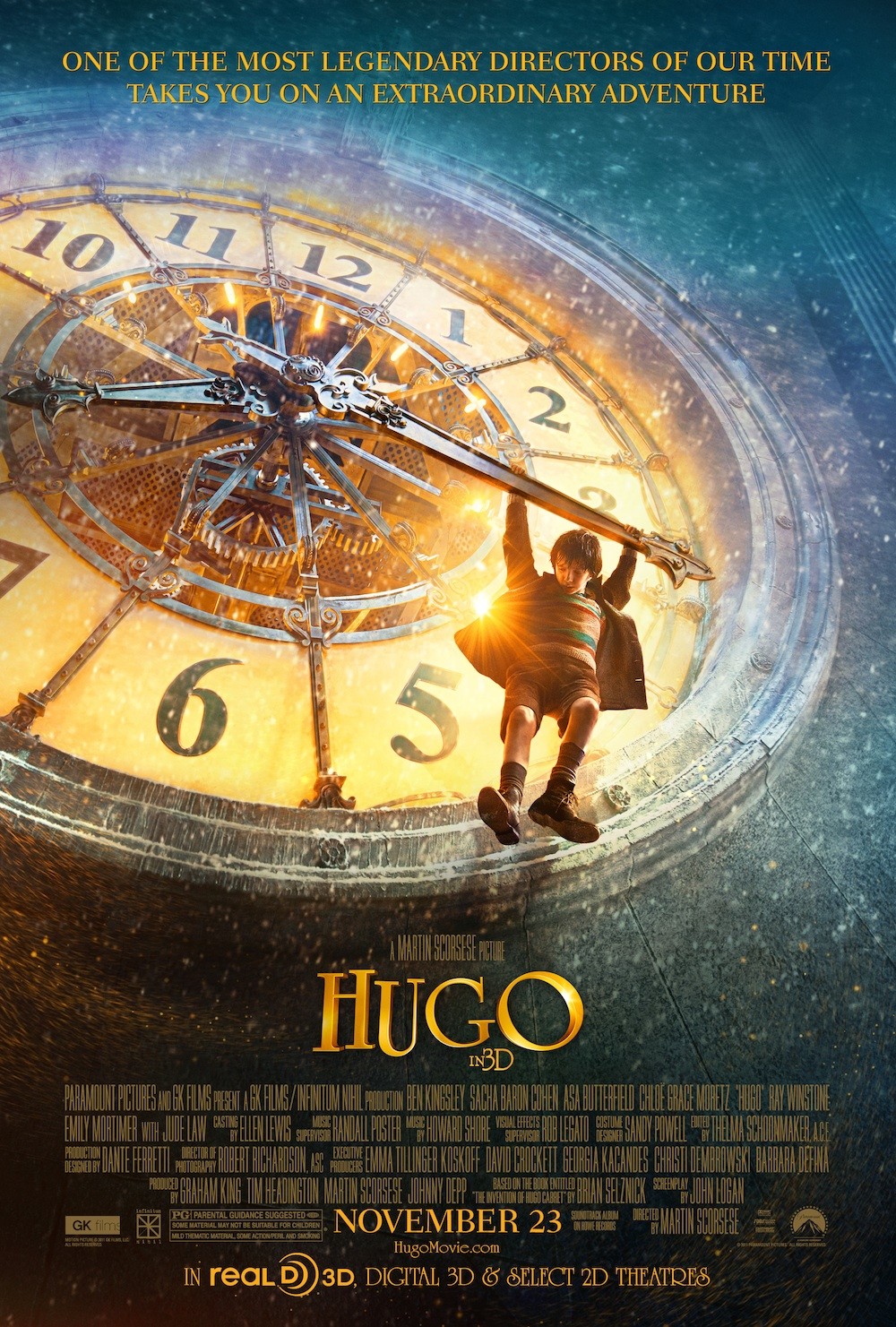
Hugo
Martin Scorcese certainly created an oddity with his film Hugo. It's based on a children's book, has a plot that centers around children, is one of his few PG rated movies, and at the end of the day it's a decent movie.Except that I can't imagine it much any appeal for children.
The studio tried to market this as a magical adventure story, but it's really more of a story about lost souls. There's the titular character, Hugo, an orphan that lives in a Paris train station. He keeps all of the clocks in the station running, while at the same time works on repairing a mysterious automaton discovered by his deceased father. Hugo is constantly evading the station inspector (Sacha Baron Cohen), a man with no other apparent purpose in life than to send loitering children off to the orphanage. Then there's Georges (Sir Ben Kingsley), a toy shop owner who comes off as uncommonly cruel after he catches Hugo trying to steal a wind-up mouse from his shop. However, when Georges's goddaughter, Isabelle, befriends Hugo, she and Hugo find that their quest to learn more about the automaton leads them to learn about Georges's past.
Now one would think that a story involving a mysterious mechanical man would be engaging from start to finish, but the parts of the film that focus on uncovering the mystery of the automaton are actually the weakest. It's as if Scorcese had an idea of what people expected in a film where children with British accents have a wild, fantastic adventure, and tried to dress up parts of Hugo to meet that expectation. Unfortunately the automaton plot just isn't as wild and fantastic as the story treats it as being, and so the characters seem to strain themselves to make the story more perilous and complicated than it needs to be.
Fortunately, the automaton isn't what the whole movie is about. Without revealing too much of the story, the mechanical man leads Hugo and Isabelle into a far more interesting story about the early days of filmmaking. It's here that I found the characters really began to develop, and where I finally found myself growing emotionally attached to them. You can just feel Scorcese's own love for filmmaking bursting through the characters as the relive the excitement of being the pioneers of the motion picture industry. It's also this part of the story that I imagine many younger viewers would lose interest, unless they happen to be aspiring entertainers themselves. It has a very mature feel to it. Not mature in the sex and violence sense, but in the sense that it deals with the very grown up aspects of success and loss.
It's not Scorcese's best work, but it's still a well crafted movie. It doesn't exactly feel like a Scorcese movie though. I've always found his movies to have a very raw, unpolished feel to them, almost as he didn't edit the footage as thoroughly as others wood, so as to capture the immediacy of the performances. Hugo, is mostly the opposite. It's slick and clean. In some instances, it's too over-processed actually. A few years back, a blogger pointed out how filmmakers have gone overboard with digital color correction, heavily playing up the colors orange and teal. Hugo may be one of the worst examples I've seen yet, with scenes where it looks like everybody is covered in spray tan and dressed in the same bright, brilliant shade of blue. Who new early 20th century Paris was the Jersey Shore of its day?
Overall, if you do end up checking Hugo out, go in knowing that it's not the magic-filled adventure story they've tried to market this movie as, but it's still a worthwhile movie.
Friday, March 2, 2012
Chronicle
Second only to 3D, the current trend of "found footage" movies is one of my biggest pet peeves in filmmaking today. When done well, it can immerse the viewer into the story, but it's used so often these days it feels like a gimmick to cover up an otherwise weak story. Thankfully, Chronicle is among those movies that uses the technique well, even though the found footage gimmick does prove to be distracting from time to time.
Lets get one thing out of the way. Despite what the ads suggest, Chronicle is not an action movie. It's actually a somewhat dark drama about a troubled teenager. At the start of the film, we see a kid named Andrew filming himself in the mirror. He's decided he's going to film everything as a way of dealing with his problems. His father is an alcoholic, his mother is terminally ill, and the only person even close to being his friend is his cousin Matt, and even he thinks Andrew is too weird to deal with. This all changes when Matt, Andrew and a third student named Steve come across a mysterious glowing rock that gives them all telekinetic abilities.
Instead of following the cliche of deciding to become superheroes with their new powers, the three teenagers do what most of us would probably do with special abilities. They just use them to play around. While Matt and Steve are content to just leave it at that, Andrew finds himself struggling to keep himself in check as he deals with his rage from having an abusive father and from being bullied at school.
This is where the found footage aspect of Chronicle really shines. The majority of the movie is shot from Andrew's camera, and you really do get a sense of what he is going through, as a result. We see him get bullied. We see him try to fit in. We see that he really wants to be a good kid, but at the same time we see him deal with the fact he has powers that he could use to hurt the people who hurt him. As he starts to lose his sense of self restraint, you still maintain a sense of empathy for him.
Unfortunately, at times the found footage gimmick strains itself as the story has to bend over backwards to work in reasons why the characters are constantly filming themselves. For example, there's a female character who just happens to be an avid video blogger. This rather conveniently allows the director to cut back and forth between her filming Andrew, and vice versa, when they're having conversations. Worse yet, there's a huge fight scene near the end of the movie that takes place in Downtown Seattle, and one character uses his powers to surround himself with cameras stolen from visitors to the Space Needle. It serves no logical point to the story, other than to give the director more angles to shoot a dramatic dialogue exchange from, and still maintain the found footage plot device.
The found footage thing works best in films like The Blair Witch Project, where it's integral to the plot that the characters constantly film themselves, or like in Cloverfield, where an incredible event is happening in a short period of time, and it only makes sense that somebody would want to film everything. For Chronicle, the filmmakers may have been better off taking notes from District 9, a film where they used found footage as more of a framing device to set up the story, and shooting the film conventionally for scenes where it just didn't make sense for a camera to constantly be around.
Despite the occasional awkward instance of trying to force the camera into the scene as part of the story, Chronicle is overall a well shot, well acted movie about a teenager who just wants a chance a living a normal happy life in spite of his circumstances. I look forward to seeing more from the director, the writers and the actors of this movie.
Thursday, January 26, 2012
Best Movies of 2011
Some years it's easy to pick the best picture of the year because one movie clearly stood out above the rest, even if that movie doesn't end up taking home the Oscar (ahem, The Dark Knight). Some years, it's not so easy. This year, was an exceptionally good year for movies. It was so good, that I admit I ended up missing half of the award season contenders because of the large volume of critically acclaimed movies that were being released around December.
That being said, here's the top ten of the ones I did manage to catch this year:
10. Harry Potter and the Deathly Hallows pt. 2
Yes, I know I'm going to catch hell for putting this one at the bottom of the list, but the decision to break this movie up into two parts apparently meant that the filmmakers didn't feel a strong need to edit the material for the sake of keeping the pace moving along. At least part 2 was the more action packed of the finale, but it suffered a bit because most of the dramatic setup took place in part 1. Still, it was a worthy sendoff for a much beloved film series that had been running for ten years.
9. Super 8
J.J. Abram's film about the love of filmmaking was also a valentine to those 80's movies about kids having wild adventures in their own backyard that they just don't seem to make anymore. It's hard to watch this movie and not want to grab a movie camera and some friends and make a film of your own. This might also be the first movie I've seen Steven Spielberg produce and not direct that actually had the feel of a movie he might have directed himself. I did have one complaint about Super 8. It's clear that this film was two story ideas merged into one. It's a film about kid filmmakers and it's a film about a government conspiracy. We see both stories through the same characters, but as the conspiracy plot takes center stage, the filmmaking plot seems to get pushed to the side, and they never intersect as well as I think Abrams had hoped they would.
8. Mission: Impossible - Ghost Protocol
Brad Bird is one of the few animation directors out there today who has been able to make a name for himself. (Previous credits include Ratatouille, The Incredibles and the highly underrated The Iron Giant). Naturally, I was excited to see what he could do with his live-action debut, and he did not disappoint. Considering that the Mission: Impossible franchise is so easily associated with explosive action scenes, it comes as a surprise that the best moments from Ghost Protocol are so minimalist in nature. For example, in one scene Tom Cruise and Simon Pegg are trying to break into the Kremlin and only have to outsmart one guard. It's a subtle scene. No big over the top orchestral score, and minimal dialogue, and yet it keeps the tension levels high.
7. Captain America
I can't even begin to describe how glad I was that they chose to set this entire film in WWII instead of just using his WWII days as a prologue for movie set in modern times. Considering how hilariously bad previous attempts to make Captain America movies were it's good that this version managed to hit the mark. I was also impressed that they managed to come up with a reasonably plausible explanation for why a soldier would go behind enemy lines in a getup that is as far removed from camouflage as possible. Best of all, this movie makes me very optimistic about the upcoming Avengers movie, as they managed to work in references to Iron Man and Thor, and have them feel like they're part of the Captain America story.
6. Hanna
Everything about this movie felt like director Joe Wright was going out of his way to break typecasting, and it sure worked. Wright is perhaps better known for his adaptations of period pieces like Pride & Prejudice starring Keira Knightley, and the award winning Atonement. With Hanna, he delivers a kinetic action thriller that's a cult classic waiting to happen. The titular Hanna is a girl raised by her father, deep in the Scandinavian wilderness and trained for the sole purpose of assassinating a government agent. Her mission doesn't quite go as planned, and she finds herself on her own, trying to escape a rather flamboyant psychopath hired to kill her by the agent Hanna tried to kill herself. It's a heavily stylized movie with a soundtrack by the Chemical Brothers. On occasion the stylized cinematics do start to feel less like you're watching a movie and more like you're watching a music video for a Chemical Brothers song, but for the most part it gives the film a unique look and feel among action movies.
5. Rango
Nickelodeon finally seems to have gotten its act together to make serious entries into the animated film genre. Most of their previous movies were just big screen adaptations of existing shows, like Rugrats or big screen pilots for upcoming shows like Jimmy Neutron. With Rango, Nickelodeon has finally delivered something highly original more than just a movie that you drop the kids off at. I suppose some aspects of a story about a chameleon having an identity crisis may fly over the heads of some kids, (and I would hope that the references to Fear & Loathing in Las Vegas fly over the heads of all kids,) but it's a well animated western with a great voice cast that includes Johnny Depp and Bill Nighy.
4. Source Code
Source Code was certainly a fresh take on the genre of time travel stories. Despite its far fetched plot, where a soldier relives the last 8 minutes of a terrorist victim's life in order to determine the identity of the terrorist, it almost felt plausible. What's even more impressive is that director Duncan Jones manages to create a strong romantic subplot between the soldier (Jake Gyllenhaal) and a woman on the train (Michelle Monaghan) despite their interactions together being based over the same 8 minutes.
3. The Adjustment Bureau
2011 seemed to be a good year for sci-fi, with intellectual sci-fi movies like Source Code and The Adjustment Bureau being released. Despite having a sci-fi plot device central to its story, The Adjustment Bureau has a very realistic drama at its core. It's a love story where a man (Matt Damon) has to decide if the sacrifices both he and the woman he loves (Emily Blunt) must make to be together are worth it. The sci-fi twist is that only he knows there's a team working behind the scenes who are working behind the scenes to make sure they stay apart. What I really liked about this film was that it wasn't a love story told over a weekend, where a man goes nuts over a woman he just met. Instead, it's a story told over several years, which allows the audience to really believe Damon's character is truly a man fighting to be with a woman he loves. The movie also takes a pretty serious look into the ideas of destiny versus free will, which usually just get the pop-philosophy treatment in most films.
2. X-Men: First Class
I had reservations about this firm when I first heard about it. Prequels are almost always a disaster. X-Men 3 and Wolverine: Origins were both massive disappointments. It seemed inevitable that First Class would be a disaster. Instead, it turned out to be the best one of the series. It's a mix of a prequel and a reboot, tying in elements from previous movies while abandoning other parts. First Class also touched upon some of the campier elements of its comic book origins without loosing the realistic feel of previous installments. It also produced some standout performances by up and coming actors, such as Jennifer Lawrence's potral of Mystique, or Caleb Jones as Banshee. This film also proved to be one of many breakout roles of 2011 for Michael Fassbender who proved to be a worthy successor to Ian McKellen for the role of Magneto.
1. Midnight in Paris
In other years I might not have picked this movie as my Best Picture, probably deferring to a film that was more epic in scope. However, I think this movie hit a personal chord. It's about a writer, played by Owen Wilson, who wishes he could have lived in the Golden Age of 1920's Paris. One night while wandering around Paris, that wish gets granted and he finds himself schmoozing with F. Scott Fitzgerald, having his work critiqued by Gertrude Stein and trying to steal away Pablo Picasso's mistress. As a fan of so many old-time things, I suppose it's only natural that I be a fan of a movie that's about nostalgia versus living in the present.
Writer/Director Woody Allen managed to pull together a great cast, especially when it came to the actors playing the celebrities of 1920's Paris. Tom Hiddleston's portrayal of F. Scott Fitzgerald actually drove me to re-read The Great Gatsby, a book that I didn't care for when it was assigned to me in high school, but I now see why it's a classic. However, everybody in the movie took a back seat to Corey Stoll as Ernest Hemingway. I thought it was by far the best supporting actor performance I had seen all year, and was surprised that he was overlooked for the Oscar for the role.
That being said, here's the top ten of the ones I did manage to catch this year:
10. Harry Potter and the Deathly Hallows pt. 2
Yes, I know I'm going to catch hell for putting this one at the bottom of the list, but the decision to break this movie up into two parts apparently meant that the filmmakers didn't feel a strong need to edit the material for the sake of keeping the pace moving along. At least part 2 was the more action packed of the finale, but it suffered a bit because most of the dramatic setup took place in part 1. Still, it was a worthy sendoff for a much beloved film series that had been running for ten years.
9. Super 8
J.J. Abram's film about the love of filmmaking was also a valentine to those 80's movies about kids having wild adventures in their own backyard that they just don't seem to make anymore. It's hard to watch this movie and not want to grab a movie camera and some friends and make a film of your own. This might also be the first movie I've seen Steven Spielberg produce and not direct that actually had the feel of a movie he might have directed himself. I did have one complaint about Super 8. It's clear that this film was two story ideas merged into one. It's a film about kid filmmakers and it's a film about a government conspiracy. We see both stories through the same characters, but as the conspiracy plot takes center stage, the filmmaking plot seems to get pushed to the side, and they never intersect as well as I think Abrams had hoped they would.
8. Mission: Impossible - Ghost Protocol
Brad Bird is one of the few animation directors out there today who has been able to make a name for himself. (Previous credits include Ratatouille, The Incredibles and the highly underrated The Iron Giant). Naturally, I was excited to see what he could do with his live-action debut, and he did not disappoint. Considering that the Mission: Impossible franchise is so easily associated with explosive action scenes, it comes as a surprise that the best moments from Ghost Protocol are so minimalist in nature. For example, in one scene Tom Cruise and Simon Pegg are trying to break into the Kremlin and only have to outsmart one guard. It's a subtle scene. No big over the top orchestral score, and minimal dialogue, and yet it keeps the tension levels high.
7. Captain America
I can't even begin to describe how glad I was that they chose to set this entire film in WWII instead of just using his WWII days as a prologue for movie set in modern times. Considering how hilariously bad previous attempts to make Captain America movies were it's good that this version managed to hit the mark. I was also impressed that they managed to come up with a reasonably plausible explanation for why a soldier would go behind enemy lines in a getup that is as far removed from camouflage as possible. Best of all, this movie makes me very optimistic about the upcoming Avengers movie, as they managed to work in references to Iron Man and Thor, and have them feel like they're part of the Captain America story.
6. Hanna
Everything about this movie felt like director Joe Wright was going out of his way to break typecasting, and it sure worked. Wright is perhaps better known for his adaptations of period pieces like Pride & Prejudice starring Keira Knightley, and the award winning Atonement. With Hanna, he delivers a kinetic action thriller that's a cult classic waiting to happen. The titular Hanna is a girl raised by her father, deep in the Scandinavian wilderness and trained for the sole purpose of assassinating a government agent. Her mission doesn't quite go as planned, and she finds herself on her own, trying to escape a rather flamboyant psychopath hired to kill her by the agent Hanna tried to kill herself. It's a heavily stylized movie with a soundtrack by the Chemical Brothers. On occasion the stylized cinematics do start to feel less like you're watching a movie and more like you're watching a music video for a Chemical Brothers song, but for the most part it gives the film a unique look and feel among action movies.
5. Rango
Nickelodeon finally seems to have gotten its act together to make serious entries into the animated film genre. Most of their previous movies were just big screen adaptations of existing shows, like Rugrats or big screen pilots for upcoming shows like Jimmy Neutron. With Rango, Nickelodeon has finally delivered something highly original more than just a movie that you drop the kids off at. I suppose some aspects of a story about a chameleon having an identity crisis may fly over the heads of some kids, (and I would hope that the references to Fear & Loathing in Las Vegas fly over the heads of all kids,) but it's a well animated western with a great voice cast that includes Johnny Depp and Bill Nighy.
4. Source Code
Source Code was certainly a fresh take on the genre of time travel stories. Despite its far fetched plot, where a soldier relives the last 8 minutes of a terrorist victim's life in order to determine the identity of the terrorist, it almost felt plausible. What's even more impressive is that director Duncan Jones manages to create a strong romantic subplot between the soldier (Jake Gyllenhaal) and a woman on the train (Michelle Monaghan) despite their interactions together being based over the same 8 minutes.
3. The Adjustment Bureau
2011 seemed to be a good year for sci-fi, with intellectual sci-fi movies like Source Code and The Adjustment Bureau being released. Despite having a sci-fi plot device central to its story, The Adjustment Bureau has a very realistic drama at its core. It's a love story where a man (Matt Damon) has to decide if the sacrifices both he and the woman he loves (Emily Blunt) must make to be together are worth it. The sci-fi twist is that only he knows there's a team working behind the scenes who are working behind the scenes to make sure they stay apart. What I really liked about this film was that it wasn't a love story told over a weekend, where a man goes nuts over a woman he just met. Instead, it's a story told over several years, which allows the audience to really believe Damon's character is truly a man fighting to be with a woman he loves. The movie also takes a pretty serious look into the ideas of destiny versus free will, which usually just get the pop-philosophy treatment in most films.
2. X-Men: First Class
I had reservations about this firm when I first heard about it. Prequels are almost always a disaster. X-Men 3 and Wolverine: Origins were both massive disappointments. It seemed inevitable that First Class would be a disaster. Instead, it turned out to be the best one of the series. It's a mix of a prequel and a reboot, tying in elements from previous movies while abandoning other parts. First Class also touched upon some of the campier elements of its comic book origins without loosing the realistic feel of previous installments. It also produced some standout performances by up and coming actors, such as Jennifer Lawrence's potral of Mystique, or Caleb Jones as Banshee. This film also proved to be one of many breakout roles of 2011 for Michael Fassbender who proved to be a worthy successor to Ian McKellen for the role of Magneto.
1. Midnight in Paris
In other years I might not have picked this movie as my Best Picture, probably deferring to a film that was more epic in scope. However, I think this movie hit a personal chord. It's about a writer, played by Owen Wilson, who wishes he could have lived in the Golden Age of 1920's Paris. One night while wandering around Paris, that wish gets granted and he finds himself schmoozing with F. Scott Fitzgerald, having his work critiqued by Gertrude Stein and trying to steal away Pablo Picasso's mistress. As a fan of so many old-time things, I suppose it's only natural that I be a fan of a movie that's about nostalgia versus living in the present.
Writer/Director Woody Allen managed to pull together a great cast, especially when it came to the actors playing the celebrities of 1920's Paris. Tom Hiddleston's portrayal of F. Scott Fitzgerald actually drove me to re-read The Great Gatsby, a book that I didn't care for when it was assigned to me in high school, but I now see why it's a classic. However, everybody in the movie took a back seat to Corey Stoll as Ernest Hemingway. I thought it was by far the best supporting actor performance I had seen all year, and was surprised that he was overlooked for the Oscar for the role.
Thursday, October 27, 2011
Black Aggie: Washington DC's Haunted Statue
When I was a kid I had a thing for reading tales of allegedly true ghost stories. I kept going back to them, even though they terrified the hell out of me. Some of the stories popped up in several of the books I read, such as the Berkeley Square Horror, or the Borley Rectory, but one of my favorite stories appeared in only one book stocked by my local library.
It was the tale of Black Aggie, a statue that would supposedly come to life at night. The story, as I remembered it from the book, was that the statue was angel carved out of black marble and it served as a grave marker. Not long after it was put in place, tales about the statue began to spring up. People claimed that at night it would stroll about the cemetery or that it would blind you if you stared into its eyes at night. Grass wouldn't grow in its shadow.
Eventually the statue caused such a commotion that the family had it removed from the cemetery and donated to the Smithsonian Institution, who then hid it deep in storage, not wanting to take any chances of supernatural phenomena occurring if it were put on display. The book, the name of which I have sadly forgotten, had a single illustration of the statue, showing a black angel with glowing red eyes against a moonlight sky. If anybody knows the book this is from, please let me know, as I would like to credit it.
Unfortunately for years, that was all the information I had on the Black Aggie. It wasn't until the internet started to proliferate that I could find enough information to verify the story. Of course, the internet, being what it is, I found a good amount of versions of the tale that seemed to merge it with other urban legends. A popular one merged it with the story of the college student who took on a dare to spend a night sleeping on the statue's lap, only for him to be found the next morning dead of fright. (I'd usually heard the story told without the statue. The dare was that the student was dared to stick a knife in a grave plot. Something holds him to the plot and won't let go, and he dies of fright convinced that the dead body below was grabbing his foot, when in reality he'd stuck the knife through his pant leg.)
Eventually, through sites such as this, or this, I found more information that filled in some of the gaps of the half remembered story, and suggested there was some truth to it after all. For one thing, it turns out the statue was actually an unauthorized copy of another statue known as the Adams Memorial, (sometimes referred to simply as "Grief") The Adams Memorial was made in 1891 by Augustus Saint-Gaudens, and commissioned by Henry Adams for his wife marion who had committed suicide. The original still resides in Rock Creek Cemetery in Washington D.C.
The unauthorized copy was made by Edward L.A. Pausch and purchased by General Felix Agnus for his family plot in Druid Ridge Cemetery, in Baltimore, Maryland. It was this statue that became known as Black Aggie, although according to Wikipedia, the legend sometimes was mistakenly attributed to another statue in Druid Ridge Cemetery that represented the greek fate Clotho. They are similar in appearance, and the Clotho statute is actually of an angel, which may account for Black Aggie being described as one in some versions of the story, such as the book I previously mentioned. However, as the Wikipedia article states, it isn't likely to be the statue of the legend because among other things, there's no reason for it to be named "Aggie."
The one fact I was glad to find on doing my research as an adult was that the part about the Smithsonian losing the Agnus Memorial in storage was false. In fact, the statue is currently on display in the rear courtyard of the Dolley Madison House on Lafayette Square in Washington, D.C. In 2008, I was passing through D.C. and decided to see the statue for myself.
Standing in front of the Dolley Madison House, at first glance it appeared that the courtyard was inaccessible from the street, due to the way the house was adjoined to the nearby buildings. However, it turned out the courtyard was rather easy to reach from the street. Starting in front of the house, just take a right on H Street, and then turn right under the first archway in the red brick building right next to it. If you're not looking carefully, it may just look like an alleyway or an entrance to the brick building but it leads right behind the Dolley Madison House.
The Black Aggie, in it's current setting looked more serene than terrifying. When I saw it in the courtyard, it was in the shade, nestled between several bushes (none of which appeared to have any difficulty growing around it.) I suppose at night it may have been a bit unnerving to walk past, but in the daylight, the statue, and the courtyard it sat in, looked like a nice quiet place to visit to ease a bit of midday stress.
When I went home that night, I did a bit more research on Black Aggie and the Adams Memorial that it was based off of. I thought about seeing the original Adams Memorial, but passed on that idea upon learning it was all the way in Baltimore. However, it turned out that there was a second, authorized replica of the Adams Memorial on display in the national gallery.
It seemed I wasn't the only person who was interested in the statue because when I asked the guard where the Adams Memorial was, he told me that I was the fifth person to ask about the statue that week and he wanted to know if it was mentioned in a book or something. I didn't really care to get into the backstory about Adams and Agnus Memorials, so I just told him I thought it was an interesting statue and moved on.
Oddly enough, the Adams Memorial, the one that didn't have any ghost stories about it, seemed creepy to stand in front of. It sat alone at the end of a hallway. I took a picture of it with my Holga camera, which seemed to exacerbate the creepiness factor of it when I got the photo developed, especially since the way the camera flash hit the eyes, it made them seem to glow a bit. Had I seen the real Black Aggie when I was kid, I would have simply thought it was cool statue, but had I seen the Adams Memorial, it would have certainly haunted my nightmares.
Update:
So I found an illustration from the ghost story book I mentioned, unfortunately the site didn't have any information about the book itself. If anybody recognizes the book from this illustration, I'd greatly appreciate it, as I'd like to credit that book for introducing me to this tale.
It was the tale of Black Aggie, a statue that would supposedly come to life at night. The story, as I remembered it from the book, was that the statue was angel carved out of black marble and it served as a grave marker. Not long after it was put in place, tales about the statue began to spring up. People claimed that at night it would stroll about the cemetery or that it would blind you if you stared into its eyes at night. Grass wouldn't grow in its shadow.
Eventually the statue caused such a commotion that the family had it removed from the cemetery and donated to the Smithsonian Institution, who then hid it deep in storage, not wanting to take any chances of supernatural phenomena occurring if it were put on display. The book, the name of which I have sadly forgotten, had a single illustration of the statue, showing a black angel with glowing red eyes against a moonlight sky. If anybody knows the book this is from, please let me know, as I would like to credit it.
Unfortunately for years, that was all the information I had on the Black Aggie. It wasn't until the internet started to proliferate that I could find enough information to verify the story. Of course, the internet, being what it is, I found a good amount of versions of the tale that seemed to merge it with other urban legends. A popular one merged it with the story of the college student who took on a dare to spend a night sleeping on the statue's lap, only for him to be found the next morning dead of fright. (I'd usually heard the story told without the statue. The dare was that the student was dared to stick a knife in a grave plot. Something holds him to the plot and won't let go, and he dies of fright convinced that the dead body below was grabbing his foot, when in reality he'd stuck the knife through his pant leg.)
Eventually, through sites such as this, or this, I found more information that filled in some of the gaps of the half remembered story, and suggested there was some truth to it after all. For one thing, it turns out the statue was actually an unauthorized copy of another statue known as the Adams Memorial, (sometimes referred to simply as "Grief") The Adams Memorial was made in 1891 by Augustus Saint-Gaudens, and commissioned by Henry Adams for his wife marion who had committed suicide. The original still resides in Rock Creek Cemetery in Washington D.C.
The one fact I was glad to find on doing my research as an adult was that the part about the Smithsonian losing the Agnus Memorial in storage was false. In fact, the statue is currently on display in the rear courtyard of the Dolley Madison House on Lafayette Square in Washington, D.C. In 2008, I was passing through D.C. and decided to see the statue for myself.
The Black Aggie, in it's current setting looked more serene than terrifying. When I saw it in the courtyard, it was in the shade, nestled between several bushes (none of which appeared to have any difficulty growing around it.) I suppose at night it may have been a bit unnerving to walk past, but in the daylight, the statue, and the courtyard it sat in, looked like a nice quiet place to visit to ease a bit of midday stress.
When I went home that night, I did a bit more research on Black Aggie and the Adams Memorial that it was based off of. I thought about seeing the original Adams Memorial, but passed on that idea upon learning it was all the way in Baltimore. However, it turned out that there was a second, authorized replica of the Adams Memorial on display in the national gallery.
Oddly enough, the Adams Memorial, the one that didn't have any ghost stories about it, seemed creepy to stand in front of. It sat alone at the end of a hallway. I took a picture of it with my Holga camera, which seemed to exacerbate the creepiness factor of it when I got the photo developed, especially since the way the camera flash hit the eyes, it made them seem to glow a bit. Had I seen the real Black Aggie when I was kid, I would have simply thought it was cool statue, but had I seen the Adams Memorial, it would have certainly haunted my nightmares.
Update:
So I found an illustration from the ghost story book I mentioned, unfortunately the site didn't have any information about the book itself. If anybody recognizes the book from this illustration, I'd greatly appreciate it, as I'd like to credit that book for introducing me to this tale.
Labels:
artwork,
ghosts,
halloween,
photography,
travel
Subscribe to:
Posts (Atom)